A patio at four in the afternoon and the same patio at half past eight are two different rooms. The one you arranged in daylight is the one your guests will actually sit in, and by then the light will be doing most of the work. Lanterns are not decoration you sprinkle on at the end; they are the reason someone can find their glass, their chair, and the step down to the lawn.
So treat setup as a sequence rather than a shopping spree. Read the space at dusk, decide what each area actually needs, place the large pieces first, then fill in around them. Done in that order, the patio looks intentional instead of studded with lights.
Walk the Space at Dusk, Not at Noon
Before you move a single lantern, go outside at the hour your guests will arrive. Sit in a chair. Then stand where someone would step out from the house. Notice which corners go dark first, where interior light spills through the windows, and whether a neighbor's porch lamp or a streetlight is already doing part of your job. You may need less than you think on that side of the patio and more than you expect on the other.
Carry one lantern with you and set it down in five or six different spots. A single light placed well — beside a step, behind a planter, at the end of a bench — often does more than three placed at random. This walk is also when you spot the uneven paver and the coil of hose you'll be tripping over in the dark. Fix those while you can still see them.
Break the Patio Into Three Zones
Most patios look wrong at night for one reason: every area gets lit the same way. Guests need three different kinds of light, and each zone has its own rules.
Seating
Here the goal is faces, not floor. Lanterns should sit slightly behind and to the side of where people sit, so the glow lands on shoulders and cheekbones without shining into anyone's eyes. As a working rule, keep nothing at seated eye level within arm's reach — that means no tall lantern directly on the table between two chairs. Two lanterns at either end of a sofa, one low on a side table, and one on the ground behind the group usually reads warmer than a bright cluster in the middle.
Walkways
Path lighting is a guidance system, not a runway. Space lanterns roughly six to eight feet apart and alternate sides so the route curves gently rather than marching in a straight line. Keep them low — ankle to knee height — so the light skims the ground and shows the edge of the path. If a lantern could be knocked over by a guest walking past, it is too close to the walkway.
Food and Drink
This is the brightest zone on the patio, because people need to see what they're eating. Use a cluster of three lanterns at different heights around the table or buffet: one low, one at table height, one hanging or on a raised surface. Add a single lantern to the drink station so nobody pours in the dark. Keep scented candles away from the food — citronella beside a cheese plate is a mistake you only make once.
Set the Anchors Before Anything Small
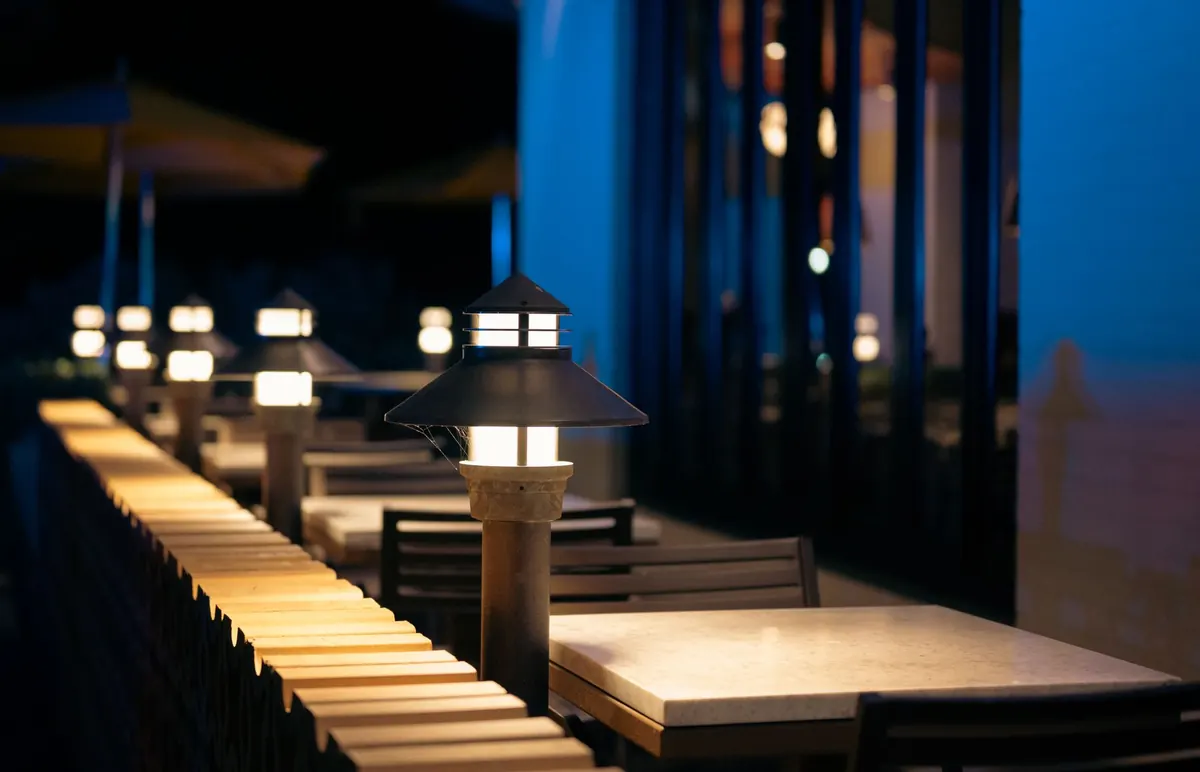
Anchors are the two or three largest lanterns you own. Place them first, because everything else is arranged in relation to them. Good anchor spots are the outer corners of the gathering area or the far edge of the patio, where they pull the eye outward and make the space feel larger than it is. A big lantern with one steady light reads as a landmark; it gives the eye somewhere to rest.
Space anchors roughly ten to twelve feet apart, then adjust by walking between them. If you can stand in the gap and see nothing but black, the gap is too wide. If the two lanterns wash into one bright pool, they're too close.
Fill In the Middle Layer
With anchors in place, add the middle-height lanterns: table lanterns, lanterns on planters and low walls, and any hanging pieces. If you're hanging lanterns from a pergola, an umbrella arm, or a branch, keep the bottom of the lantern above the sightline of someone standing — around six and a half to seven feet off the ground. Hanging lights that dangle at face height feel festive for about four minutes and irritating for the rest of the evening.
Then, and only then, add the small pieces: a miniature lantern at the base of a planter, one on the step, one on the windowsill behind the seating. These are details, not structure.
Balance the Light
A patio lit evenly in brightness looks flat. A patio lit evenly in coverage looks calm. Those are different goals, and the second one is what you want.
- Use three heights. Ground, table, and above head height. All one height flattens the space.
- Stick to warm white. Bulbs in the warmer range look amber rather than clinical; cool blue-white light makes food and skin look wrong after dark.
- Let there be dim corners. Shadows give the light somewhere to sit. A patio with no dark edges looks like a parking lot.
- Fewer, larger lanterns beat many small ones. Three good lanterns read as a decision; fifteen tea lights read as an accident.
- Give every light a job. If you can't say what a lantern is for — "so people can see the step" — take it off the patio.
- Use timers where you can. Battery lanterns with a timer can be set to come on about twenty minutes before guests arrive. Test the timer the day before, not five minutes before.
Wind, Flames, and Cords
Candle flames are lovely and fussy. Put them in glass, keep them off the ground where a breeze or a passing dog can reach them, and keep them well clear of fabric, napkins, and anything that drapes. Never leave a burning flame unattended, and check your local rules if you're planning open flame on a balcony, in a rental, or near dry grass. On a breezy evening, or anywhere children and pets are moving fast, use battery or rechargeable lanterns instead. Nobody has ever regretted choosing the safer light.
Weight matters more than people expect. Give tall lanterns a heavy base, or drop a layer of sand or pebbles into the bottom. Run cords behind furniture rather than across the walkway, and tape down anything that crosses a path. If a cord has to cross open ground, route it along the edge and cover it.
Test Run, Then Stop Adding
Twenty minutes before guests arrive, turn everything on and stand where you'll greet people. Walk the path slowly. Look for the dark pool near the grill, the glare in the corner chair, the lantern that's only visible from one side. Ask someone else to walk it too — a second pair of eyes catches things you've stopped seeing.
Keep spare batteries and one spare lantern within reach, because the lantern that dies will always be the one lighting the steps. Then leave it alone. Once the patio is warm and readable, more light rarely improves it, and the best-lit gathering spaces are usually the ones where someone had the restraint to stop at just enough.
Photo: Chris F / Pexels